You are likely not chasing visuals. You are chasing better mornings, fewer cravings, steadier focus, and work that flows without the grind. That is what most people mean when they say microdosing helps. Not magic. Not hype. Just a small shift that feels nice.
If you are new to microdosing, the noise can be confusing. Protocols compete. Results vary. Some people feel nothing; others feel a quiet lift that changes how their day unfolds. This guide gets practical so you can run a clean experiment and decide for yourself.
We cover microdosing protocols that respect rest days; how psilocybin neuroplasticity may support flexible thinking; what counts as safe microdose ranges; and simple microdosing rituals that turn intention into results. Clear, grounded, no jargon.
Consistency Before Complexity
Before diving into myths and protocols, remember one simple truth: a microdose only works if you can trust what you are taking. A capsule at 0.2 g should feel like the next 0.2 g. Too often, it doesn’t. Strains differ. Substrates differ. Even two flushes from the same grow can create different baselines.
Without that stability, your notes and rituals lose meaning. The dose you record today may not match the dose you feel tomorrow. Consistency is what turns a scattered experiment into a clear practice.
Clarity begins when the same number on the scale means the same shift in your mind.
That is why careful drying, blending whole harvests into a uniform powder so each dose feels consistent, and measuring with precision matter so much. Emerging brands such as Kensho Elements are finding traction by making consistency their foundation, focusing less on hype and more on transparency and reliability.
[Editor’s Note: Consistency is underrated. Without it, the logbook you keep is a novel without chapters.]
Myth 1: Microdosing makes you instantly smarter
 This myth lingers because it sounds so tempting; the “limitless pill” idea, a shortcut to brilliance. Controlled trials have not shown measurable IQ jumps, and if that is the only definition of smarter, then the myth falls flat. But intelligence is not just numbers on a test, and microdosing is not that simple.
Science reports on averages. People live their own data. Group studies flatten nuance. Imagine a trial where ninety percent of participants feel little to nothing, but ten percent describe profound clarity and creative breakthroughs. On paper, the study reads “inconclusive.” For the ten percent, the impact is life-changing.
Add to that early evidence suggesting psilocybin can support neuroplasticity (the brain’s ability to form new pathways), and a different picture emerges. Paired with healthy routines like good sleep, nutrition, and exercise, long-term microdosing could foster more flexibility in thought and perception. That is not the same as instant genius, but it may be a quiet, cumulative sharpening of the mind.
And definitions matter. If “smarter” means higher test scores, the answer is probably no. If it means lateral thinking, creative flow, or the ability to step out of mental loops, then yes — many people do feel something shift. Someone with ADHD-like traits may feel less caught in repetitive thought. A strategist may see connections where before there were only straight lines. A designer may sketch with fewer doubts holding them back. These shifts are subtle, but to the person experiencing them, they feel like a form of intelligence unlocked.
In practice, mushrooms often work less like an upgrade to the engine and more like a lens adjustment. The world remains the same, but the way you see it changes. That alone can unlock new ideas, and for many, that is enough.
Science is about averages. Your life is not an average.
[Editor’s Note: What is smarter? More numbers, or more angles? Mushrooms rarely inflate the engine; they widen the lens.]
Myth 2: Daily microdosing is the gold standard
Some early chatter suggested daily use was best. In reality, most community protocols have always built in rest days. James Fadiman’s classic schedule is one day on, two off. Paul Stamets’ popular stack runs four on, three off, often paired with Lion’s Mane and niacin.
These weren’t arbitrary. Psychedelics act on serotonin 5-HT2A receptors, which desensitize with repeated stimulation. In higher doses, tolerance builds quickly. Research from as far back as the 1970s showed daily psilocybin or LSD use rapidly lost effect, and sensitivity only returned after several days off.
At microdose levels (100–300 mg), it’s less clear. Some researchers argue the dose is too small to trigger strong downregulation. Placebo-controlled microdosing studies have not found conclusive tolerance effects. Still, many in the community report that daily use feels “flat” after a week or two, while spacing out doses keeps the subtle benefits noticeable.
In practice: variation matters. Cycling days, or even varying the dose slightly, keeps the body responsive. Community wisdom and pharmacology converge on the same point. Give your system space, and it will give back more.
Microdosing works like training: growth comes from strain and rest, not from repetition without pause.
[Editor’s Note: Varying the dose itself matters too. Mix 0.1 g with 0.2 g, occasionally 0.3 g. Keep the body responsive. Don’t let the system adapt so fully that the practice loses its edge.]
Myth 3: A small dose is automatically safe
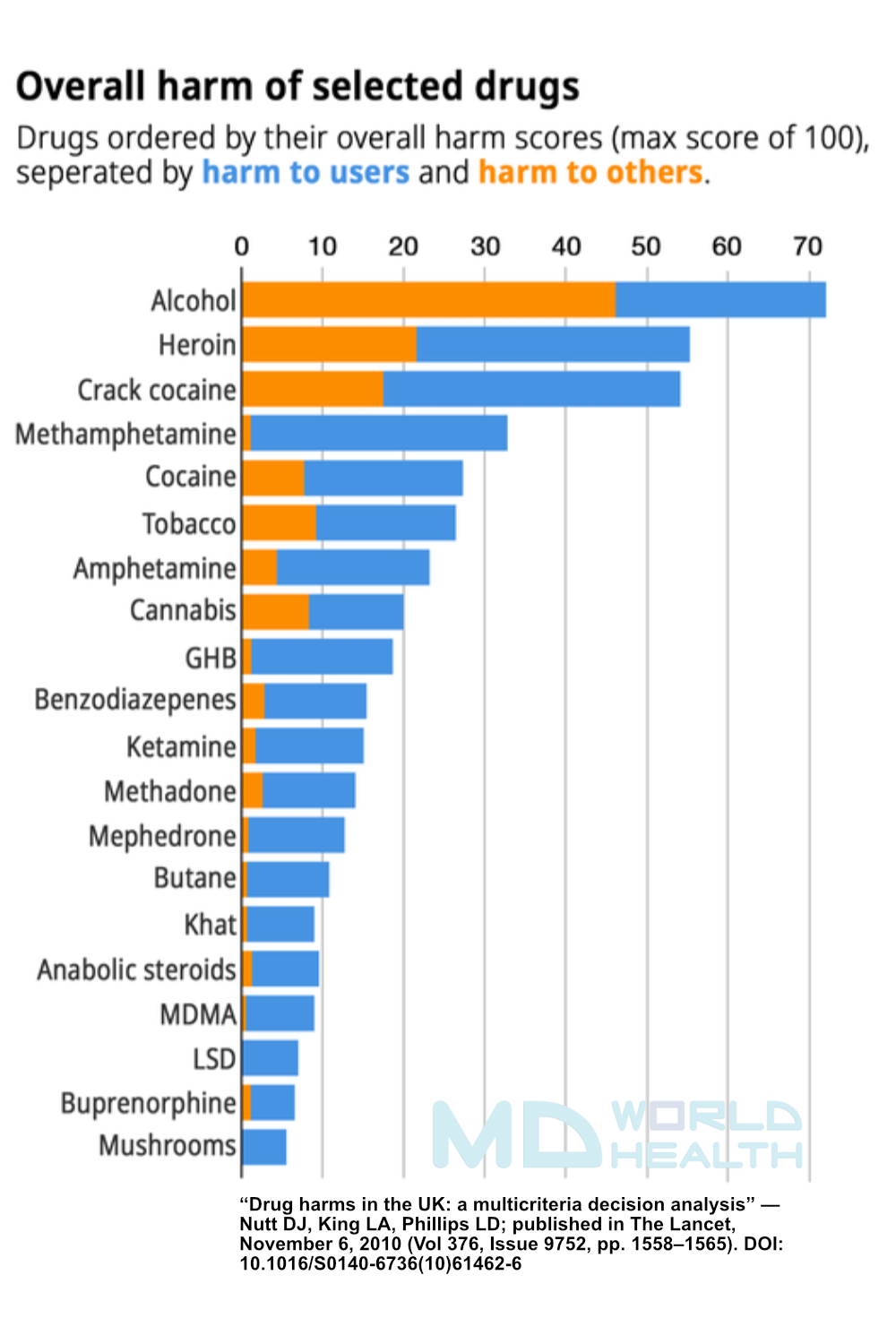
Here’s the inversion most people miss. In comparative studies, psilocybin mushrooms rank as one of the least harmful substances humans use… far below alcohol, tobacco, and even caffeine. On David Nutt’s harm scale, alcohol scored at the top for overall harm. Mushrooms sat at the very bottom. That matters.
Mushrooms are safer on paper than the beer or cigarette in your hand.
No one has ever died from a true microdose… or even a macrodose, as far as recorded science shows. That doesn’t mean consequence-free. People do report side effects: disrupted sleep if taken late in the day, stomach upset in sensitive guts, or anxiety when the environment feels off.
The bigger variable is potency. One gram of Golden Teacher is not the same as one gram of Penis Envy. These are different strains of psilocybin mushrooms, and their psilocybin content can vary dramatically. Even two flushes of the same strain can diverge if one was grown on rye berries and the other on a richer substrate.
A deeper problem is how products are being made. Many new sellers rush cultivation. They grow mushrooms fast on cheap substrates, then market capsules or chocolates labeled as “3.5 g.” On paper, the math works. In practice, the potency does not. Someone takes half a gram from a weak batch and calls that their baseline. Maybe they even push up to one or two grams over time. Then one day, they try a gram from a well-grown strain, slow cultivated on rich substrate, properly dried and handled, and it feels overwhelming. Instead of realizing the earlier products were inferior and underpowered, they conclude “real” mushrooms are too much for them.
The problem isn’t the mushroom. The problem is inconsistency.
This is how poor cultivation and corner-cutting distort perception. People get attached to weak baselines and shy away from the genuine article when they finally encounter it. The solution is not to abandon quality, it’s to learn your true dose by starting low with consistent, well-grown material.
Microdosing is low-risk, but not no-risk.
[Editor’s Note: Worth saying directly. No deaths from microdosing or even full-dose. But “small” doesn’t mean “safe for everyone, always.” Strain, source, and individual sensitivity all matter.]
What’s a True Microdose?
There’s a lot of confusion around the word microdose. Many people new to psychedelics say they’re microdosing when in reality they’re taking a vibing dose, or threshold amount, enough to feel light visuals or perceptual shifts. A true microdose should stay below that line.
- Microdose (100–300 mg / 0.1–0.3 g dried mushrooms): Sub-perceptual. Below the threshold of visuals. Subtle shifts in mood, focus, or creativity.
- Microdose (up to 0.5 g for milder strains): With less-potent strains, some remain sub-perceptual up to 500 mg. Potency creates overlap.
- Vibing or “Museum” Dose (0.5–1.5 g): Noticeable but functional. Colors perception, emotions, and music/art without being overwhelming.
- Macrodose (1.5–3.5 g / ~⅛ oz): Classic psychedelic trip. Visuals, time/space shifts, strong inner work.
- Strong Macrodose (3.5–5 g): Deeper intensity; pronounced alterations and expansive inner landscapes.
- Heroic Dose (5 g+): Profound ego dissolution and archetypal experiences; difficult to describe afterward.

Strain and Potency Matter
Boundaries blur because psilocybin content varies by strain and cultivation. A gram of Golden Teacher is not the same as a gram of Penis Envy. Two grams from different substrates can feel like two completely different journeys. Respect variability and always start lower when trying a new source.
If you’re slightly tripping, you are not truly microdosing.
[Editor’s Note: Personally, I don’t rely much on microdosing. I’m already (somewhat) grounded and happy, so I don’t feel the need for a daily boost. My work with mushrooms happens at the other end of the spectrum… in hero doses that strip me bare and show me who I really am, or who/what I have the potential to become. When I microdose, my brain knows something’s there, but the “juice” isn’t strong enough to carry me. It feels frustrating, almost humiliating, like being teased with a door that won’t open. A one-gram vibing dose, though, I respect. It lets the door slip open just enough to get a little drunk on the happy juice of consciousness, without falling all the way through. It gives me the beauty without the intensity… and the responsibility of the full journey. Still, my teachings remind me that even subtle experiences matter. Some of the most transformative lessons I’ve had came not from the heroic, but from the humble one-gram dose.]
Rituals That Shape the Experience
Microdosing is not just a capsule and a clock. The frame around the dose often determines whether it becomes a practice or just another supplement.
Nature walks with frequency-based music
Many people pair a light dose with a slow walk outdoors. The best audio companions are wordless: ambient, electronic, classical, or meditation tones. The goal is not a soundtrack that drags attention away from your immediate surroundings… or yourself, but tones that act like a tuning fork. You notice breath. You notice birds. You notice color and texture. You are not thinking about the past or narrating the future. You are present and moving. That’s often where the subtle lift becomes most obvious.
Journaling as data
It’s not busywork. It’s your personal dataset. Write a few lines before you dose: intention, mood, energy, focus. Write again a few hours later. Do the same on off days. After a few weeks you will see patterns no group study can give you, because the sample is you. If writing isn’t your jam, try photography. Taking photos of your surroundings while microdosing is a great way to stay present, and over time, you’ll see how (visually) your artistic viewpoint has evolved.
Creative flow practices
Microdosing does not make the work for you. It helps reduce friction while you do the work. Coders often notice easier context switching. Musicians report smoother improvisation. Writers describe a lower threshold to start and a steadier rhythm once moving. The output is not always grand. The practice is the point.
Integration time
This is the hidden half. Without it, microdosing is just consumption. Sit quietly for ten minutes after a walk or work block. Breathe. Stretch. Note what shifted and what didn’t. Put one insight into tomorrow’s plan. That is how small shifts accumulate into real change.
Without integration, microdosing is just consumption.
Rituals for cravings and habits
One of the most practical and under-discussed effects. Microdosing seems to act like wet cement during and after the dose. What you press into it may harden. Skip cigarettes, alcohol, or sugar before and after, and the ease of saying no often lasts for days or weeks. This is a VERY powerful tool. It may have the power to help people quit bad habits, but… and it’s a BIG but… if you do the opposite, you may reinforce the very loop you want to break. Pair the dose with tea, breathwork, or nutrient-dense foods, and you train your brain that “good” feels like that.
The mushroom reinforces what you do, not only what you intend.
What the Science Is and Is Not Saying
Controlled microdosing research is still early. Sample sizes are small. Doses vary. Designs differ. Some studies report mild improvements in mood, anxiety, and attention. Others find no measurable difference. Expectation is powerful. In self-blinding citizen trials, both microdose and placebo groups improved. The average difference between groups was small, so the papers read “inconclusive.”Placebo or not, if it helps you, it helps you.
Trials report group averages. Averages erase responders. Many antidepressants only help a subset, often one-third. Yet they are considered effective at the population level. Microdosing may follow the same arc: benefit for some, not all, and group statistics flatten that nuance.
People report flow and mood lift. Cognitive tests sometimes show modest or no change. That does not mean nothing happened. It means our tools are better at measuring large, immediate shifts than subtle, long-arc ones. Journaling fills that gap. If you start easier, finish more, and feel less friction, that is valid data even if a lab test is neutral.
Then there is belief. Faith in God cannot be measured in a lab, yet it transforms lives. Microdosing blends chemistry, ritual, and belief in the same way. If the practice makes life calmer, more open, or more creative, that is valid data for the person living it. Clinical science will keep catching up. In the meantime, you can hold caution and meaning at once.
[Editor’s Note: Do not wait for science to hand you permission slips. Use science as a guide. Run your own experiment with intention and records.]
Real-World Reports and Perspectives
Microdosing isn’t lived in a vacuum. The science gives one story, but the people taking these doses across generations, professions, and lifestyles, bring another. What shows up in studies as “inconclusive” can feel very different when you’re the one noticing your mood shift on a walk, or your creativity spark during a project.
It’s not just Gen Z and Millennials experimenting. Gen X and Boomers are here too; some curious, some cautious, some quietly finding their own rhythms. For Gen X, microdosing feels like revisiting an old landscape. They grew up breaking rules, testing limits, experimenting in a world without social media chasing them down. Boomers carry echoes of the 1960s golden years, when psychedelics first lit up culture and counterculture alike. Teachers, nurses, software engineers, even police officers and local officials now add their voices.
That mix of lived history and present-day practice shows us microdosing isn’t just a Silicon Valley hack or wellness trend. It’s a thread weaving across generations; re-emerging, reshaping, and embedding itself in daily life in unexpected ways.
- Gen Z: wellness curious, less alcohol, more psychedelics as lifestyle. Microdosing for creativity, social ease, and mood steadiness. Often combined with breathwork and yoga.
- Millennials: high stress, parenting and careers. Microdosing to reduce rumination, soften anxiety, and maintain focus across context switching. Often combined with mushroom coffee, gym training, and meditation.
- Gen X: often skipped in headlines, but very present. Many touched psychedelics in the 90s and now return for focus, clarity, and healthspan. A bridge generation, comfortable with both counterculture history and modern biohacking.
- Boomers: exploring microdosing for mood lift, social openness, and gentle cognitive support. Often careful with timing and sleep.
Professions in practice: Teachers use it to ease social anxiety and feel more patient. Engineers and designers use it to break creative ruts. Healthcare workers use it on days off to downshift stress and reconnect with empathy. Small business owners use it to plan and prioritize without spiraling.
From Hack to Quiet Revolution
The old stereotype of a Silicon Valley productivity trick feels dated. Microdosing is now a quiet, local phenomenon inside ordinary lives. The legal map reflects that. Cambridge, Massachusetts has decriminalized psychedelic mushrooms’, and yet a short drive away it is still considered a crime. Colorado and Oregon have moved further. Other states remain strict. Quiet revolutions often start with cracks like this — many small changes rather than one headline event.
Legalization brings mixed feelings. The cannabis story showed how counterculture can be absorbed and taxed. People in psychedelic communities and many indigenous voices worry mushrooms will be reduced to products and protocols and stripped of spiritual depth. Mushrooms are not just compounds. They are teachers in traditional settings. They belong to community as much as to clinics. The healthiest path forward will include both clinical care and community care with respect for tradition.
Set, Setting, and Safety
Before getting practical, it’s worth remembering that microdosing isn’t just about the dose. The experience lives in context… who you are that day, where you are, and why you’re doing it. “Set and setting” is a phrase often used in psychedelic circles, and it applies as much to small doses as it does to larger journeys.
Think of it this way: the mushrooms may whisper, but the room you’re in, the mindset you carry, and the habits you keep will decide how clearly you hear them. That’s why safety isn’t only about what’s in the capsule, it’s about the frame you put around it.
- Mindset: Enter with intention, not desperation. Dosing to escape a crisis is rarely wise. Dosing to explore or support growth is better ground. [Editor’s Note: Always do mushrooms to find yourself, never to lose yourself.]
- Environment: Choose calm and safe spaces. Stressful settings amplify risk and blunt subtle benefits.
- Harm reduction: Start low. Use cycles rather than daily use at first. Track outcomes. Avoid stacking with alcohol or stimulants. Respect medications that interact with serotonin.
- Measurement: Use a precise scale. Homogenize source material. Capsule consistently. Do not eyeball.
- Trip killers, just in case: Microdosing rarely needs them. If a dose misfires upward, calming supports such as chamomile, valerian, CBD, light carbohydrates, and vitamin C can help you settle. Stay hydrated. Rest.
- Potency reminder: One gram is not one gram across strains and substrates. Respect variability. Adjust slowly. Poorly cultivated, low-potency mushrooms give false baselines. Consistent, well-grown material gives clarity.
Supplier trust matters because consistency is what makes microdosing predictable. Kensho Elements is a brand that focuses on microdose-optimized products with careful sourcing and repeatable methods. Consistency turns 0.2 g into 0.2 g rather than a roulette spin. It also reduces noise in your personal data so your conclusions are cleaner.
From Hack to Quiet Revolution
The Takeaway
Microdosing is neither magic nor madness. It lives at the crossroads of ritual, science, culture, and commerce. For some it sparks creativity. For others it reduces stress, softens cravings, or reconnects them with community. It is no longer fringe. It is part of modern wellness.
Placebo or not, if it helps you, it helps you.
Hold two truths. Keep humility about what research can confirm today. Keep respect for lived outcomes that make real days better. Bring intention. Keep records. Respect variability. Let results speak.